The Switch to Alternative Search Engines

mojeek
18 May 2026
3 min
The Switch to Alternative Search Engines
The trend towards alternative tech has generated lots of lists to help people make the switch. Mail, Office, Drive, Video, Maps… an amazing array of choice for a sovereign, secure and sustainable digital life. Search engines - your gateway to the web - are an essential part of an alternative toolkit so here’s an informed comparison to make the right choice.
Search engines determine more than the results you see. Are they really independent of Big Tech? Who controls your data? Is your personal information truly private? Are your searches genuinely powered by clean energy? Where does all the money go? Not all search engines are created equal so let’s dig into some details which might surprise you.
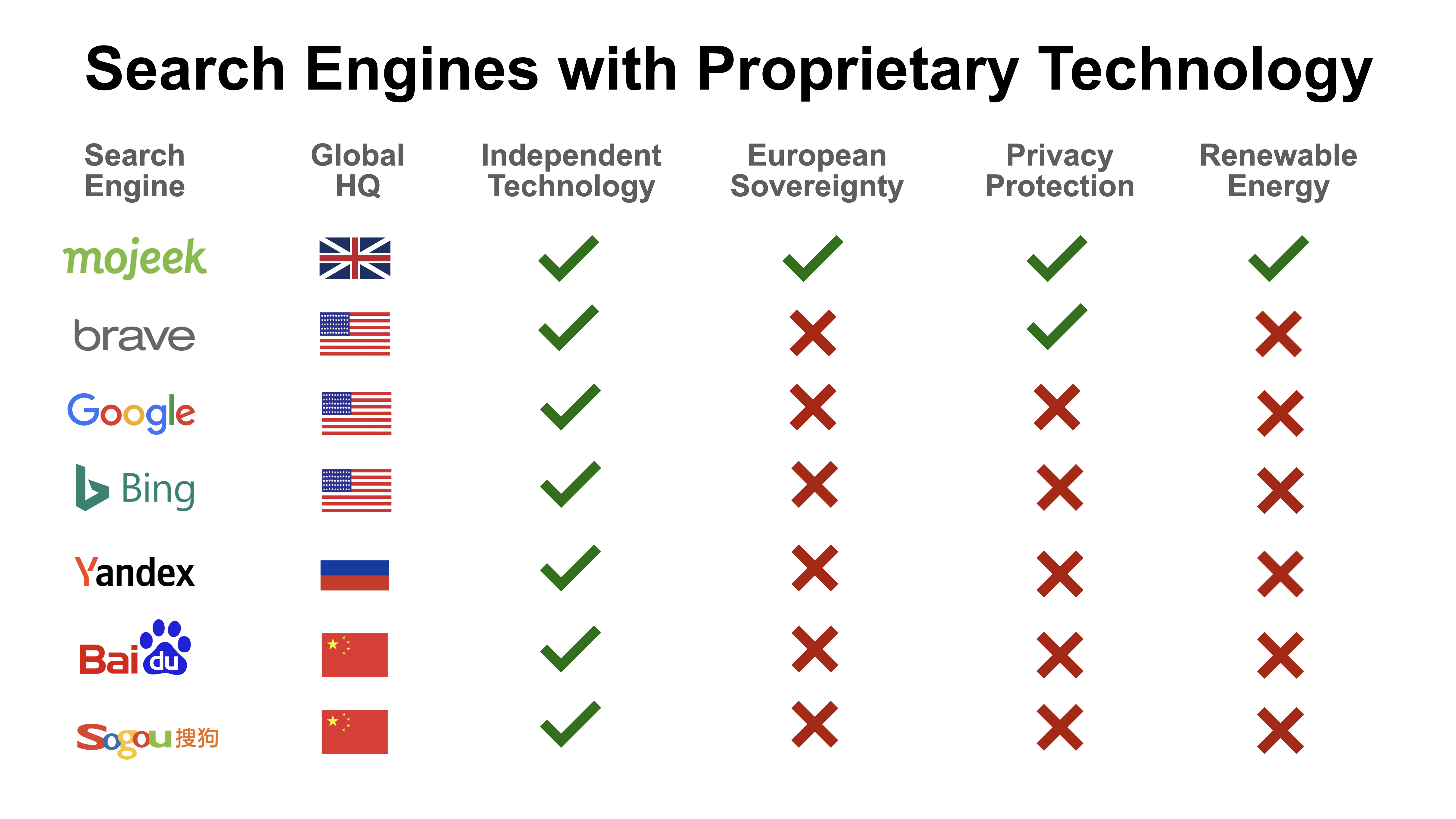
Independent Search Technology
The most fundamental question about any search engine is: do they crawl and index the web themselves or do they just repackage results from someone else’s search engine? This matters enormously. If a search engine relies on Google or Bing, they're not really an alternative, they're a front-end to the same monopolisation of the search engine market. When the underlying tech owners change commercial terms or alter algorithms, all dependent engines are affected.
True independence is rare. The US, China, Russia and South Korea have built their own search infrastructure. In Europe, Mojeek stands alone, after two decades building an independent search engine with proprietary web crawler, search index and ranking algorithms. It’s not easy, it takes time and investment, which is why many alternative search engines are dependent on technology from US companies like Google, Microsoft and Brave to deliver search results.
European Digital Sovereignty
Sovereignty isn’t about nationalism or just a proprietary tech stack. It’s where the data flows and where the money goes that’s also important. European data laws, like GDPR, protect citizens however US companies, under the CLOUD Act, could access your data even if the US company has a European data centre. If a European search engine is powered by US tech then your data flows to the US. The clash of ideologies (EU regulation vs US deregulation) will only intensify as 12 interlocking EU laws, including the AI Act, become enforceable.
Paying Google, Bing or Brave to deliver a European-flavoured search engine is definitely easier than crawling the web yourself and building a proprietary search index. But if you follow the money, you discover a commercial dependence on US companies which ultimately means euros turn into dollars. Many European search engines are reliant on Google and Microsoft advertising networks to generate revenue and grow their business. Sovereignty is more than a flag, it ensures your economy and data aren't controlled by third parties.
Privacy Protection Rights
Privacy is the most commonly cited reason for choosing an alternative to Google but not all "privacy-focused" search engines offer the same level of protection. The privacy paradox is many "private" search engines protect your privacy from tracking but they still send your queries to the mothership. You're not being profiled, but you're still feeding the data mining ecosystem. The warning sign is the complexity of respective privacy policies. You know, the ones you can never actually read.
True privacy requires true independence. Mojeek was the first privacy-focused search engine with the first no data tracking privacy policy in 2006. The length of a privacy policy often correlates with how much data is being collected. Complex data practices require complex legal language. Over 20mins to read Google’s privacy policy, at least 10mins for DuckDuckGo and only 2min for Mojeek.
Renewable Green Energy
Billions of search queries are processed every second of every day through an intricate choreography of servers, data centres, cooling systems and network infrastructure. The hidden cost of ‘free’ searches is energy consumption and carbon emissions with AI summaries of search results compounding the environmental impact by as much as 100 times. Your choice of search engine – and how you search information – is a genuine environmental choice.
It’s worth checking the provenance of the entire search engine infrastructure, from servers to website, to understand how green your searches truly are. Mojeek’s commitment to the environment started in 2013 with servers based in the UK’s greenest data centre so renewable energy starts at source. If a search engine is dependent on back-end tech, like Google, Bing or Brave, then an informed choice needs to be based on the entire supply chain. On the front-end, there are great tools like Website Carbon which estimate carbon emissions.
The Bottom Line
The switch to alternative tech is about your priorities and choosing the option which aligns with your values. Is it independence from Big Tech, sovereign choices on data and the economy, your privacy or the environment? Understanding what each engine actually offers — beyond their marketing — helps you make that choice with your eyes open. One thing is clear: the dominance of Google and Microsoft over global search infrastructure is a strategic vulnerability, an economic problem and a democratic risk. Supporting genuine alternatives isn't just about sovereignty, security and sustainability, it's about maintaining a diverse and resilient information ecosystem.
Your search engine is a daily vote for the kind of internet you want to exist. Choose accordingly.
mojeek
18 May 2026
3 min
